
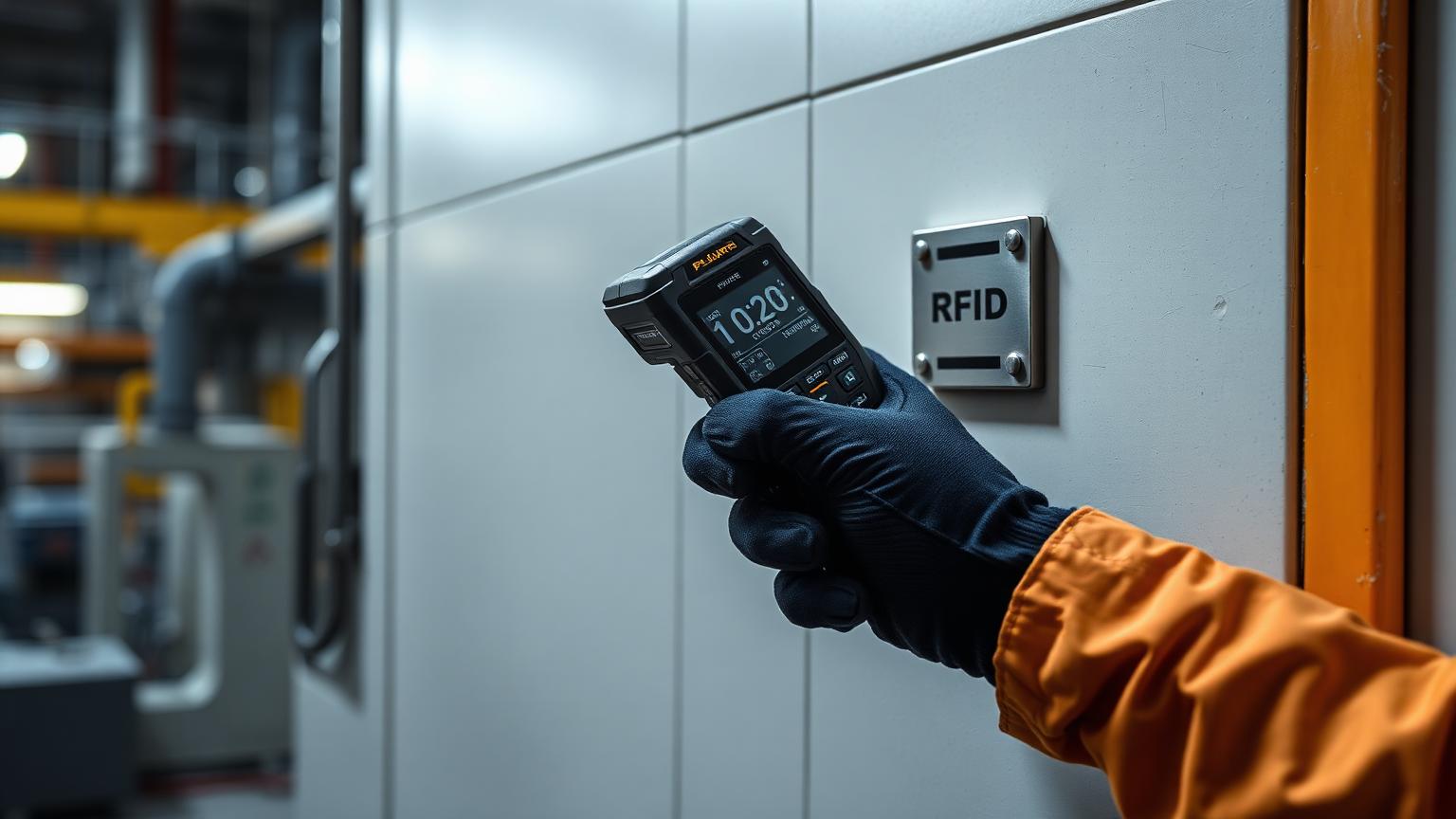
Quick answer: An RFID guard tour system uses a handheld reader to scan radio-frequency identification (RFID) tags placed at checkpoints along a patrol route. It is a proven, durable method for verifying that guards have physically visited key locations, especially in harsh industrial or outdoor environments where phones with QR or NFC apps might fail.
I remember a sprawling cement factory I consulted for outside of Sharjah. The air was thick with fine dust, it was blazing hot, and the supervisors were constantly complaining that their patrol data was patchy. Their guards were using a QR code based app on cheap smartphones, but the cameras were always smudged with grease and dust, and the screens would crack from being dropped. It just wasn’t working.
We switched them to a classic RFID guard tour system. We installed tough, plastic RFID checkpoints sealed with epoxy and gave the guards simple, rugged readers often called “pipes” or wands. No screen, no camera, just a solid metal stick. The problem was solved almost overnight. That was six years ago, and that same system is still on the job today. For all the talk of modern apps, sometimes the old ways are the best for tough jobs.
Running patrols on paper registers? See live checkpoint tracking in action. Check GuardPatrolling plans and pricing.
What is an RFID Guard Tour System and How Does it Work?
Let’s get the basics out of the way. An RFID patrol system is a combination of hardware and software designed to prove a guard has walked a specific route. It’s the digital version of the old watchclock systems where a guard carried a key and turned it in lockboxes along his route.
The system has three main parts:
- RFID Checkpoints: These are small, passive tags, usually encased in plastic or resin discs. “Passive” means they have no battery or power source. They are simply programmed with a unique ID and you mount them on walls, fences, or machinery at critical points on the patrol route. I’ve installed thousands of these; they can be glued, screwed, or even embedded in concrete.
- The Guard Tour Reader: This is the handheld device the guard carries. It’s a battery-powered reader (often called a wand, pipe, or baton) with an antenna at the tip. When the guard touches the tip of the reader to an RFID checkpoint, the reader powers the tag for a millisecond, reads its unique ID, and stores it in its internal memory with a date and timestamp.
- The Software: After the patrol is finished, the guard brings the reader back to the control room. You connect the reader to a computer, usually with a USB cable, and use software to download all the stored scans. The software then turns this raw data (Tag ID + Timestamp) into a patrol report, showing which locations were visited and when, and highlighting any missed checkpoints.
Key Facts About RFID Patrol Systems
- Operating Frequency: Most common systems use 125 kHz low-frequency (LF) RFID. This is an older, reliable standard perfect for short-range applications.
- Read Range: It’s a contact-based technology. The guard must physically touch the reader to the checkpoint. We’re talking a read range of maybe 1-3 centimeters, tops. This is a feature, not a bug, as it proves presence.
- Durability: The tags are extremely tough. They are waterproof, dustproof, and can handle massive temperature swings from -40°C to over 85°C. I’ve seen them survive fires and chemical spills. The readers are also built like tanks.
- No Real-Time Data: This is the single biggest drawback. You only get the patrol data after the shift is over and the reader is downloaded. It is a historical record-keeping system, not a live tracking tool.
- Cost: A good reader can cost anywhere from $200 to $500. Tags are cheaper, typically $1 to $3 each depending on the type and quantity. This initial hardware cost is something you don’t have with QR code systems that use the guards’ own phones.
Where RFID Still Beats QR Codes and NFC (My Top 3 Use Cases)
I will be the first to admit, for about 80% of the sites I work on now, like office buildings, hospitals, and residential communities, I recommend a modern, app-based system using NFC or QR codes. With a live, cloud-based app, you get live data, photos, and incident reporting uploaded instantly.
1. Heavy Industrial and Manufacturing Sites
Think steel mills, cement factories, and vehicle manufacturing plants. These places are full of dirt, grease, oil, and metal dust. A smartphone camera lens for scanning QR codes becomes useless in about five minutes. Screens get scratched and become unresponsive to touch. NFC on a phone works better, but the phones themselves are points of failure. The rugged, sealed body of an RFID reader has no screen, no camera lens to clean. The guard just touches the pipe to the point. It beeps. Done. Move on.
2. Outdoor, All-Weather Environments
I’ve set up patrols for large solar farms in the UK and gated communities in India during monsoon season. Rain, snow, mud, and extreme temperatures are the enemy of consumer electronics like smartphones. Batteries drain fast in the cold. Screens don’t work well when wet. RFID readers and tags, on the other hand, are built for this. The tags are completely sealed. The readers are often IP67 rated, meaning they can be fully submerged in water. For any site where guards are patrolling outside in harsh weather, RFID is the most reliable option.
3. When You Need Zero Guard Distractions
This is a subtle but important point. Giving a guard a smartphone for patrols also gives them a web browser, games, and messaging apps. Yes, you can use lockdown software, but it’s often complex and can be bypassed. A simple RFID “pipe” does one thing and one thing only: it records scans. There is no temptation to watch a video or browse Facebook. For high-security zones or when you are dealing with a workforce where discipline is a concern, the simplicity of the RFID reader is a major advantage for ensuring focus on the job.
RFID vs. QR Code vs. NFC: A Practical Comparison
Choosing the right checkpoint technology is critical. I’ve seen projects fail because the wrong choice was made for the environment. Here’s a simple table breaking down my experience with the three main options. For a deeper dive, you can read my comparison of QR codes vs NFC specifically.
| Factor | RFID | NFC | QR Code |
|---|---|---|---|
| Durability | Excellent. Tags are fully sealed and impact-resistant. Readers are extremely rugged. | Good. Tags are similar to RFID, very durable. Relies on a smartphone, which is a weak point. | Poor. Paper or vinyl stickers fade, get dirty, or can be torn off. Needs a clear camera view. |
| Environment | Best for harsh, dirty, wet, outdoor conditions. | Good for most indoor and some outdoor uses. Not ideal in very wet or dirty sites. | Indoor use only. Requires good lighting and a clean surface. |
| Cost | Medium. High initial hardware cost for readers. Tags are inexpensive. | Low. Uses existing smartphones. Tags are inexpensive. | Very Low. Can use existing phones and print codes for free. |
| Guard Experience | Very Simple. Just touch the reader to the tag. No training needed. | Simple. Unlock phone, open app, tap the tag. | Can be slow. Unlock phone, open app, aim camera, wait for focus. |
| Data Sync | Manual. Data is downloaded via USB cable at the end of a shift. | Live. Scans upload to the cloud instantly via cellular or Wi-Fi. | Live. Scans upload to the cloud instantly via cellular or Wi-Fi. |
The 3 Sites Where I Refuse to Use an RFID System
Honesty is important. While I champion RFID for tough jobs, I actively advise against it in many common scenarios. It creates more problems than it solves if you use it in the wrong place. Here are three site types where I will tell a client “no” if they ask for a classic RFID system.
1. Sites Needing Real-Time, Live Tracking
If a client’s primary goal is to see where their guards are *right now*, RFID is the wrong tool. A supervisor at a shopping mall or large hospital needs to know immediately if a patrol is missed, not 8 hours later. For this, you need a live system. Modern apps provide this live view, allowing for immediate response. If real-time supervision is the goal, you need proper security guard tracking software, not a historical RFID system.
2. Sites Requiring Rich Incident Reports
A guard finds a water leak, a broken fence, or an unauthorized person on site. With an RFID reader, they can maybe press a button to log a generic “event,” but that’s it. They can’t provide context. A modern smartphone app lets a guard take a photo or video of the issue, type notes, and categorize the incident on the spot. This live information is gold for security managers and facility teams. For any site where you want guards to be your eyes and ears, you need a system that supports rich incident reporting.
Beyond just incident photos, modern guard tour apps provide deeper accountability and automation. For example, Guard Patrolling uses Face Verification at check-in to confirm the correct, authorized guard is starting the shift, preventing buddy punching. At the end of the day, supervisors and clients don’t have to log in to check progress; they receive automated Daily Email Reports that summarize all patrol activity, missed checkpoints, and reported incidents, delivered right to their inbox.
3. Clients with Tight Budgets and Existing Smartphones
A new security company or a small business client often has a very tight budget. Buying five RFID readers at $300 each is a $1,500 capital expense before you even start. If their guards already have smartphones (which most do), it makes far more sense to leverage that existing hardware. A QR code or NFC-based patrol app has a much lower barrier to entry. They can get the accountability they need without the upfront hardware cost. It’s about picking the most efficient solution, and sometimes that means avoiding hardware purchases. You can explore a guard patrol system pricing guide to see how app-based systems compare.
Choosing the Right RFID Reader: JWM and Beyond
If you search for RFID readers, you will constantly see the name JWM. JWM is a Chinese manufacturer that has been making these devices for years. Their wands are probably the most common in the world, often rebranded and sold by many different security suppliers. They are popular for a reason: they are cheap, reliable, and get the job done.
When selecting a reader, a “JWM guard tour system” is a safe bet for most heavy-duty applications. But here’s what to look for, regardless of brand:
- Build Quality: Does it feel solid? Is it metal or cheap plastic? Does it have an IP rating for water and dust resistance?
- Battery Life: A good reader should last for weeks of regular use on a single charge. Some even use replaceable batteries, which can be useful in remote sites with no charging facilities.
- Memory Capacity: Look for a reader that can store at least 50,000 to 60,000 scans. This prevents any data from being overwritten if a guard forgets to download the reader for a few days.
- Feedback Mechanism: The reader should give clear feedback on a successful scan. A combination of a loud beep, a strong vibration, and an LED flash is ideal, ensuring the guard knows the scan was registered even in a noisy factory.
Ultimately, the reader is just one part of the overall guard tour system. The software that interprets the data is just as important for generating useful reports.
Frequently Asked Questions
What is the main advantage of an RFID guard tour system?
The main advantage of an RFID guard tour system is its extreme durability and reliability in harsh environments. The sealed RFID tags and rugged readers can withstand water, dust, grease, and extreme temperatures that would damage or disable a smartphone-based system using QR codes or even NFC.
How far can an RFID reader scan a checkpoint?
An RFID guard tour reader has a very short read range, typically 1 to 3 centimeters. This is intentional. The guard must make physical contact between the reader and the checkpoint tag, which proves they were physically present at that specific location and not scanning from a distance.
Are RFID guard tour systems obsolete?
No, RFID guard tour systems are not obsolete, but they are a niche technology. While app-based systems with live tracking are better for most modern applications, RFID remains the superior choice for industrial, outdoor, and all-weather sites where device durability is the highest priority.
What is a JWM guard tour system?
A JWM guard tour system refers to equipment manufactured by JWM Hi-Tech, a prominent maker of RFID patrol readers and tags. Their rugged, reliable “wand” readers are widely used globally, often rebranded by local security suppliers. The name has become somewhat synonymous with the classic, durable RFID patrol reader.
Can RFID tags be easily damaged or copied?
RFID guard tour tags are highly resistant to physical damage due to their simple, passive design and tough plastic casing. They are waterproof and shock-resistant. While it is technically possible to clone a standard 125kHz RFID tag with specialized equipment, it is not a common issue in practice as it requires effort and intent.
How is data downloaded from an RFID guard tour reader?
Data is typically downloaded by physically connecting the RFID reader to a computer using a USB cable or a dedicated docking station. Specialised software on the computer then communicates with the reader to pull the stored scan records, the tag ID and timestamp, and generates patrol reports based on that data.
Bottom Line
An RFID guard tour system is far from dead. It is a specialised tool for a specific job. If you are managing security for a clean, indoor environment and need live data and photos, look elsewhere. But if you are securing a rugged, dirty, or wet site where failure is not an option, the simple, tough-as-nails RFID reader is still a security manager’s best friend. It provides undeniable proof of presence in places where modern technology fears to tread.
Ready to see how a modern system can transform your operations with real-time tracking and reporting? Explore the features and pricing of GuardPatrolling to find the right fit for your team.


