Quick Answer
A QR code guard patrol system is a technologically advanced security solution that uses scannable QR codes placed at various checkpoints to monitor guard movements and activities. This system ensures guards visit all designated locations within specific timeframes, providing real-time data on patrols, reducing human error, and enhancing overall security oversight and accountability.
Key Facts
- Over 60% of security firms are adopting digital patrol systems to improve efficiency.
- Real-time reporting helps identify and address patrol gaps immediately.
- Implementation costs can range from ₹5,000 to ₹50,000 annually, depending on scale.
- Reduces manual log errors by up to 80%.
- Enhances guard accountability through verifiable time-stamped scans.
A QR code guard patrol system uses Quick Response (QR) codes strategically placed at various checkpoints within a property. Guards scan these codes with their smartphone app, automatically logging their presence, time, and any reported incidents. This system provides real-time visibility into patrol activities, ensuring accountability and improving the overall efficiency of security operations.
What Exactly is a QR Code Guard Patrol System?
As a founder-engineer, I’ve seen firsthand how traditional guard patrolling often struggles with accountability. You put guards on a property, give them a logbook, maybe a watchman clock, and hope for the best. Pata nahin chalta ki guard time pe pahuncha ya nahin, ya koi area check kiya bhi ya skip kar diya. That’s where a QR code guard patrol system comes in. It’s essentially a digital way to verify that your guards are where they need to be, when they need to be there.
The Core Components:
- QR Code Checkpoints: These are custom-generated QR codes, waterproof and tamper-resistant, placed at specific locations like entrances, critical assets, fire exits, pump rooms, or remote corners of a property.
- Guard Patrol Mobile App: Each guard carries a smartphone with our dedicated guard patrol app. This app allows them to scan the QR codes.
- Cloud-Based Dashboard: This is your control center. Once a guard scans a QR, that data – location, time, and guard ID – is immediately sent to our cloud server. You, as the operations manager or owner, can see this in real-time from any web browser.
- Incident Reporting: More than just scans, our system allows guards to report incidents (broken window, suspicious activity, lights out) directly through the app, often with photos and notes, linked to the exact checkpoint location.
How Does a QR Code Guard Patrol System Work in Practice?
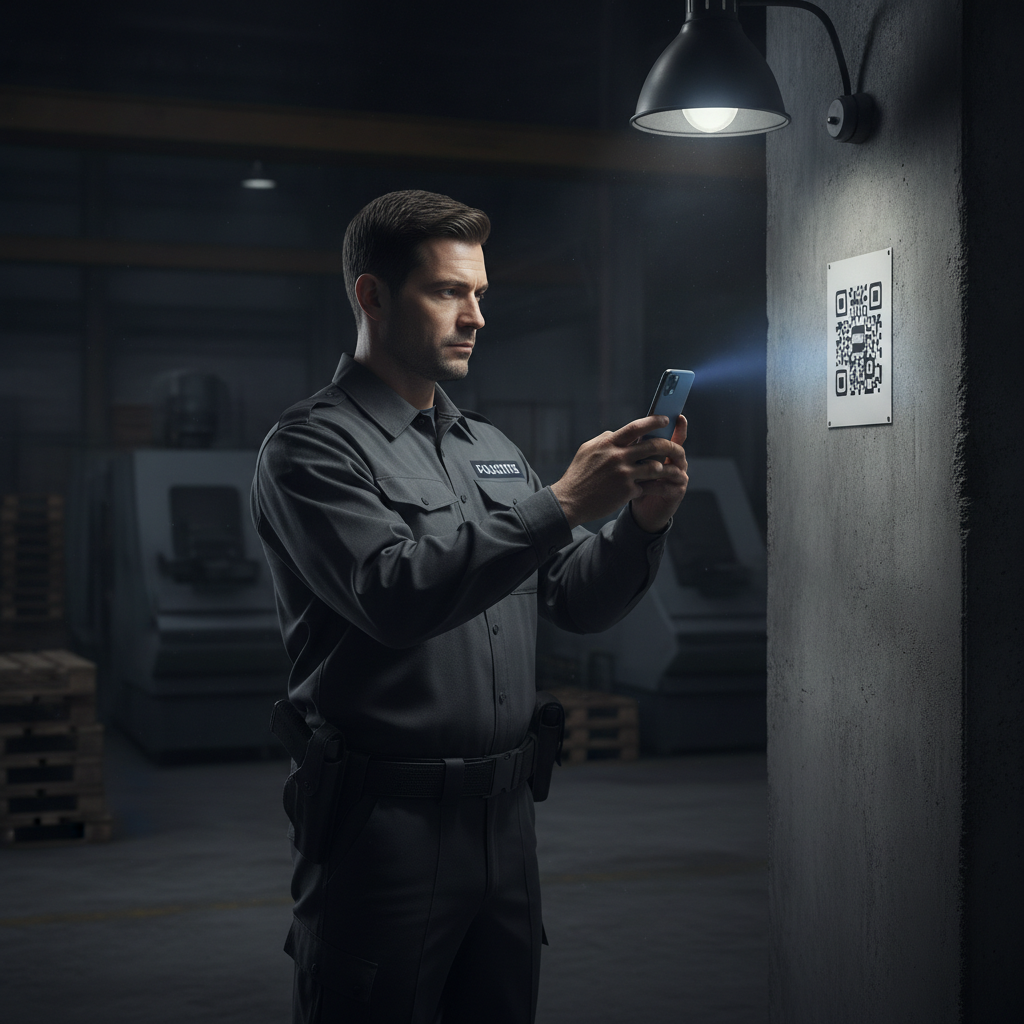
Let’s break down a typical shift. Imagine a security guard, Rajesh, starting his night patrol at a factory. He pulls out his smartphone.
Step-by-Step Flow:
- Login & Start Shift: Rajesh logs into the GuardPatrolling app on his work phone. He sees his assigned patrol route.
- Scanning Checkpoints: As he moves through the factory, he reaches a checkpoint near the main loading dock. He points his phone camera at the QR code, scans it. The app instantly records the timestamp, his GPS location (to prevent proxy scanning), and confirms the checkpoint visit.
- Incident Reporting & Task Management: While at another checkpoint near the perimeter fence, he notices a gate slightly ajar. He immediately taps “Report Incident” in the app, takes a photo, adds a brief description, and categorizes it as “Perimeter Breach – Minor.” This report is tagged with the exact location and time. He also marks a scheduled task, “Check Fire Extinguisher,” as complete after verifying it.
- Real-Time Monitoring: Back at the office, the operations manager, Priya, sees Rajesh’s scans appearing on her GuardPatrolling dashboard in real-time. She gets an instant alert about the “Perimeter Breach” incident, reviews the photo, and assigns a follow-up action.
- End of Shift & Reporting: At the end of his shift, Rajesh clocks out. The system automatically compiles a detailed report of his patrol activities, incidents, and any missed checkpoints. This report is available instantly for Priya to review for performance and billing.
Benefits for Security Companies and Operations Managers
It’s not just about tracking; it’s about transforming your security operations.
Enhanced Accountability and Transparency:
- No More Guesswork: You know exactly when and where a guard visited each point. Pata chal jaata hai ki kaunsa guard apni duties theek se kar raha hai aur kaun sa nahin.
- Reduced “Ghost Patrols”: Since GPS is often part of the scan verification (something our system does), guards can’t just scan from the comfort of the guardroom.
- Proof of Service: For your clients, you can provide irrefutable proof of service and checkpoint visits, which builds trust and justifies your pricing.
Improved Operational Efficiency:
- Faster Incident Response: Real-time incident reporting means issues are known and can be addressed much faster, minimizing potential damage or loss.
- Digital Record Keeping: Say goodbye to messy paper logbooks. All data is stored securely in the cloud, easily searchable and auditable.
- Better Resource Allocation: By analyzing patrol reports, you can identify frequently missed areas or high-incident zones and optimize patrol routes or deploy additional resources.
Cost Savings and ROI:
- Reduced Supervision Costs: Less need for physical supervision shifts; the system does the monitoring.
- Preventive Security: Consistent patrols deter crime and identify potential issues before they become major problems, saving costs associated with damage or theft.
- Optimized Billing: Accurate activity logs support precise billing to clients, preventing discrepancies.
Comparison: QR Code vs. Traditional vs. Other Digital Systems
When we talk to security companies, they often ask, “Why QR codes over magnetic wands or even NFC?” Here’s a quick comparison:
| Feature | Paper Logbook | Watchman Clock/Wand System | QR Code System (GuardPatrolling) |
|---|---|---|---|
| Initial Setup Cost | Very Low (paper, pens) | Medium (hardware specific) | Low (printing QR codes, smartphones) |
| Operational Complexity | High (manual checks) | Moderate (data downloads) | Low (smartphone app) |
| Real-time Monitoring | No | No (batch processing) | Yes |
| Incident Reporting | Manual/Verbal | Limited/Separate | Integrated (text, photos, GPS) |
| Proof of Presence | Unreliable (forgery risk) | Reliable (physical data) | Highly Reliable (GPS, timestamped) |
| Data History/Reporting | Manual Archiving | Cumbersome Software | Cloud-based, instant reports |
| Scalability | Poor | Average | Excellent |
For more on technology choices, you might find our post on QR code vs. NFC vs. RFID helpful.
What Does a QR Code Guard Patrol System Cost?
This is obviously a big question for any business owner. There’s no one-size-fits-all answer, but I can tell you what factors influence the price and what to expect from a system like ours.
Key Cost Factors:
- Number of Guards: Most systems are priced per guard per month. More guards mean a higher monthly subscription.
- Number of Checkpoints: While QR codes themselves are cheap to print, some highly customized solutions might factor this in. For GuardPatrolling, it’s generally unlimited QR codes within your plan.
- Features and Modules: Do you need advanced features like geo-fencing, lone worker monitoring, advanced analytics, or specific client portals? These can increase the cost. Our core features are designed to cover most needs.
- Contract Length: Annual subscriptions are almost always cheaper than month-to-month options.
- Hardware (Smartphones): While our software runs on standard Android and iOS phones, you’ll need to factor in the cost of providing suitable devices for your guards if they don’t use their own.
Typical Pricing Model:
You’ll usually find a SaaS (Software as a Service) model. This means a monthly or annual subscription fee. For GuardPatrolling, our plans often start from ₹500-₹1500 per guard per month, depending on the features and the number of guards. Some providers might have a one-time setup fee, but we prefer to keep it simple with clear monthly pricing.
It’s an investment, yes, but the ROI from reduced incidents, improved accountability, and streamlined operations often far outweighs the subscription cost. And remember, unlike a traditional guard monitoring system, you’re not buying expensive proprietary hardware that can break or become obsolete.
Implementing a QR Code System: Our Experience
When we roll out a new system for a client, we focus on making the transition smooth. We’ve learned a few things over hundreds of deployments.
Best Practices from the Field:
- Strategic Checkpoint Placement: Don’t just put QR codes anywhere. Think about critical areas, high-value assets, and natural patrol paths. Mix it up: indoors, outdoors, fire exits, equipment rooms.
- Guard Training: This is crucial. Your guards need to be comfortable using the smartphone app. We keep our app simple and intuitive, but a good training session (even 30 minutes) makes all the difference. Explain the “why” – it’s for their safety and efficiency, not just to track them.
- Start Small, Scale Up: If you’re new to digital systems, maybe implement it on one property or with a few shifts first. Get comfortable, then roll it out wider.
- Regular Review of Reports: The data is useless if you don’t act on it. Regularly check patrol reports, incident logs, and missed checkpoints to continuously improve your security posture.
This approach has helped our clients, from small businesses to large industrial sites, integrate our guard monitoring software effectively.
Frequently Asked Questions
How accurate is a QR code guard patrol system?
A QR code system is highly accurate for verifying checkpoint visits, as it logs the exact time and location of the scan. When combined with GPS verification (as in GuardPatrolling), it ensures the guard was physically at the checkpoint.
Can QR codes be tampered with?
While QR codes can theoretically be copied or covered, our system employs features like GPS validation and anti-spoofing measures. Using tamper-evident or durable, waterproof QR stickers also helps mitigate risks.
What if a guard misses a QR code scan?
The system is designed to alert operations managers to missed scans in real-time. This allows for immediate follow-up with the guard to understand why it was missed and ensure the area is eventually checked.
Do guards need their own smartphones?
No, you can provide company-issued smartphones. Our app runs on both Android and iOS, so you have flexibility. Using company phones can ensure consistent device quality and control access.
Is an internet connection always required?
For real-time data transmission, yes, an internet connection is needed. However, many modern guard patrol apps (including ours) have an offline mode. Scans and incidents are stored locally on the device and automatically uploaded once an internet connection is restored.
How long is the data stored?
At GuardPatrolling, we store your patrol data securely in the cloud for an extended period, typically several years, allowing for historical analysis, audits, and compliance requirements. You can access it anytime from your dashboard.
Implementing a QR code guard patrol system like GuardPatrolling is a significant step towards modernizing your security operations. It brings transparency, efficiency, and accountability that traditional methods simply can’t match. If you’re looking to tighten up your patrols, improve incident response, and provide better service to your clients, it’s worth exploring. We even offer a free trial so you can experience it firsthand with your team. Check out our pricing plans and detailed features to see how we can help your security business grow.
At a Glance
| Feature | Basic | Pro | Enterprise |
|---|---|---|---|
| Checkpoints | Up to 20 | Up to 100 | Unlimited |
| Reporting | Daily/Weekly | Real-time Alerts | Customisable KPIs & Dashboards |
| Mobile App | Basic Scan/Report | Advanced Features (Task mgmt.) | Integrated Workforce Management |
| Support | Email/Phone | 24/7 Dedicated Account Manager | |
| Pricing (Monthly approx.) | ₹500 – ₹1,500 | ₹2,500 – ₹7,500 | ₹10,000+ (Custom) |
Frequently Asked Questions
What is a guard patrol system and how does it work?
A guard patrol system is a solution for monitoring security guard movements and activities. It works by having guards scan checkpoints at predetermined locations, usually with a mobile app or dedicated device, which records their presence and time-stamps the visit for accountability and proof of patrol.
What are the benefits of using a QR code guard patrol system?
The benefits include enhanced accountability, real-time activity monitoring, reduced paperwork, improved data accuracy, and the ability to quickly verify guard presence at critical locations. It also provides actionable insights into patrol effectiveness and adherence to routes.
How much does a QR code patrol system typically cost?
The cost of a QR code guard patrol system varies significantly based on features, number of guards, and scale of deployment. Basic systems might cost ₹500-₹1,500 per month, while comprehensive enterprise solutions for large-scale operations could exceed ₹10,000 monthly, plus initial setup fees.
Can a QR code guard patrol system be integrated with other security solutions?
Yes, many QR code guard patrol systems offer API integrations, allowing them to connect with video surveillance, access control systems, and broader facility management platforms. This creates a unified security ecosystem for more comprehensive oversight and automated responses.
Is there a free QR code security guard checkpoint system available?
While fully featured, free QR code security guard checkpoint systems are rare, some providers offer limited free trials or basic versions for a small number of checkpoints or guards. These are useful for evaluation but may lack advanced reporting or features for robust operations.
What equipment is needed for a QR code guard patrol system?
Typically, you need QR codes printed and placed at checkpoints, smartphones or ruggedised devices for guards to scan the codes, and a cloud-based software platform for data management and reporting. Some systems may include additional features like NFC tags or GPS tracking.